

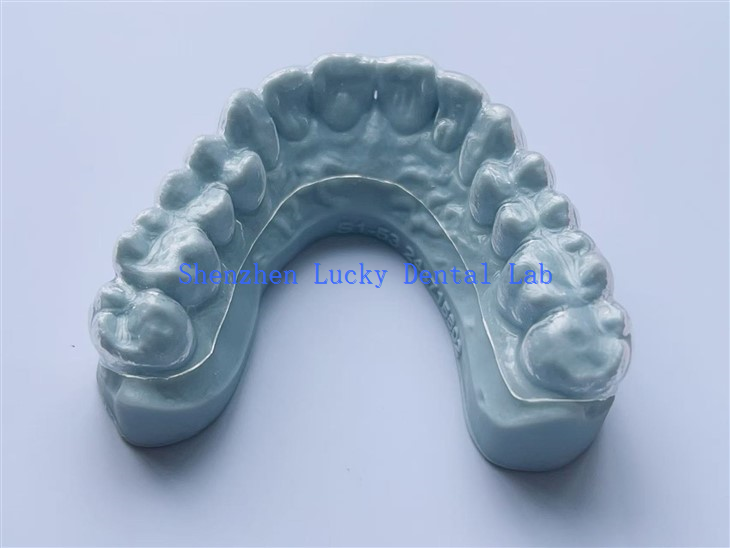
Shenzhen Lucky Dental Laboratory Co., Ltd. is one of the leading manufacturers and suppliers of 3d print bleaching tray dental lab in China. With abundant experience, we warmly welcome you to buy discount 3d print bleaching tray dental lab from our factory. We also accept customized orders.
Products Description
3D Print Bleaching Tray Dental Lab
A bleaching tray is a custom-fabricated dental appliance designed for controlled tooth whitening, crafted with precision in prosthodontic applications. Made from medical-grade thermoplastic materials (e.g., ethylene-vinyl acetate copolymer), it features a anatomically contoured design that adapts to the patient's dentition, ensuring uniform contact with tooth surfaces while minimizing gum irritation. Digital scanning or alginate impressions are used to generate a 3D model, from which the tray is vacuum-formed or 3D-printed to achieve 0.2–0.5mm thickness for optimal bleaching agent retention and distribution. Key design considerations include marginal seal integrity, occlusal clearance, and interproximal adaptation, all critical for preventing agent leakage and enhancing treatment efficacy in restorative dentistry.
Product Details
|
Manufacturer |
Lucky Dental Lab |
|
Quality |
Great |
|
Customer service |
Professional |
|
Shipping Carrier |
UPS, FedEx, DHL, etc. |
|
Guarantee |
5 years |
|
turnaround time |
3 days in lab |
Picture

FAQ
Can you provide some examples of medical-grade thermoplastics used in bleaching trays?
Medical-grade thermoplastics applied in bleaching trays typically include the following examples:
1. Ethylene-Vinyl Acetate (EVA) Copolymer
Characteristics: High flexibility, excellent biocompatibility, and resistance to degradation by bleaching agents (e.g., hydrogen peroxide).
Advantage: Adapts smoothly to tooth contours while minimizing gum irritation.
2. Polyethylene (PE)
Characteristics: Low density, chemical stability, and good moisture resistance.
Advantage: Lightweight and durable, suitable for maintaining the tray's shape during repeated use.
3. Polypropylene (PP)
Characteristics: Rigid structure with high heat resistance and chemical inertness.
Advantage: Maintains dimensional stability during vacuum forming or 3D printing, ensuring precise fit.
4. Polyvinyl Chloride (PVC)
Characteristics: Customizable hardness (from flexible to rigid) and cost-effectiveness.
Advantage: Often used in phthalate-free formulations to meet medical safety standards.
5. Polyurethane (PU)
Characteristics: Elastic memory and high tensile strength.
Advantage: Provides a snug fit to dentition, enhancing agent retention and patient comfort.
6. Polymethyl Methacrylate (PMMA)
Characteristics: Transparency, rigidity, and resistance to abrasion.
Advantage: Enables visual monitoring of bleaching agent distribution while maintaining structural integrity.
These materials are selected for their biocompatibility, moldability, and ability to withstand the chemical environment of whitening agents, ensuring both safety and treatment efficacy.