


Shenzhen Lucky Dental Laboratory Co., Ltd. is one of the leading manufacturers and suppliers of 3d print dental valplast flipper in China. With abundant experience, we warmly welcome you to buy discount 3d print dental valplast flipper from our factory. We also accept customized orders.
Products Description
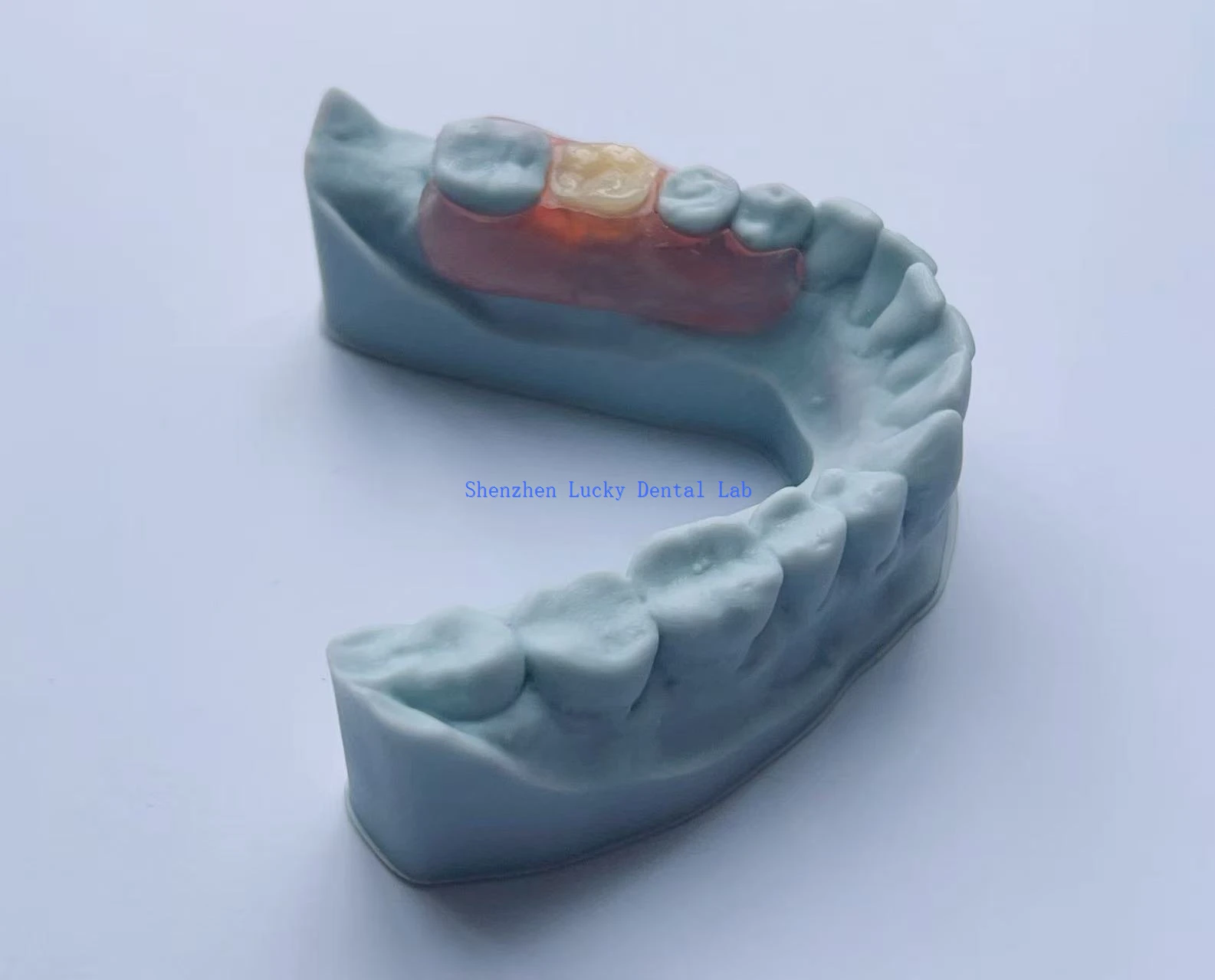
3D Print Dental Valplast Flipper
The Dental Valplast Flipper is a unilateral flexible partial denture fabricated with Valplast nylon resin, featuring a lightweight, biocompatible framework that adapts to mucosal contours via elastic memory properties. Its design integrates precision retention through undercut utilization without metal clasps, ensuring minimal tooth reduction. The framework's flexural modulus allows resilient load distribution, while the acrylic denture tooth exhibits anatomical cusp morphology for occlusal harmony. Indicated for single/multiple tooth replacement in the anterior/posterior arch, it prioritizes tissue preservation through a thin, border-sealed base that minimizes irritation. Ideal for transitional or permanent use, this flipper balances esthetics, function, and periodontal health with its non-metallic, radiolucent structure.
Product Details
|
Manufacturer |
Lucky Dental Lab |
|
Quality |
Great |
|
Customer service |
Professional |
|
Shipping Carrier |
UPS, FedEx, DHL, etc. |
|
Guarantee |
5 years |
|
turnaround time |
3 days in lab |
Picture
FAQ
How does the design of a Valplast flipper differ from other types of partial dentures?
The Valplast flipper differs from other partial dentures in key ways:
Material: It uses elastic Valplast nylon resin instead of metal, making it flexible and radiolucent. This allows the framework to bend and fit mucosal contours without rigid parts, and it doesn't block X-ray views of underlying tissues.
Retention: Unlike traditional partials with metal clasps, it uses tooth undercuts for retention. This means no visible hardware, less tooth shaping, and fewer plaque traps.
Flexibility: The resin's flexural modulus distributes chewing forces evenly across gums and teeth, unlike rigid metal frameworks that can stress specific teeth. Its thin (1–1.5 mm) base is more comfortable and conforms to ridges.
Esthetics: The resin can match gum color, ideal for front teeth. Traditional partials may have less natural-looking pink acrylic bases and visible clasps.
Use Cases: It's great for short-term or metal-free needs, but best for narrow tooth gaps. Rigid partials suit long-term, high-stress use (like back teeth in bruxism cases).