


Shenzhen Lucky Dental Laboratory Co., Ltd. is one of the leading manufacturers and suppliers of co cr cast metal framework in China. With abundant experience, we warmly welcome you to buy discount co cr cast metal framework from our factory. We also accept customized orders.
Products Description
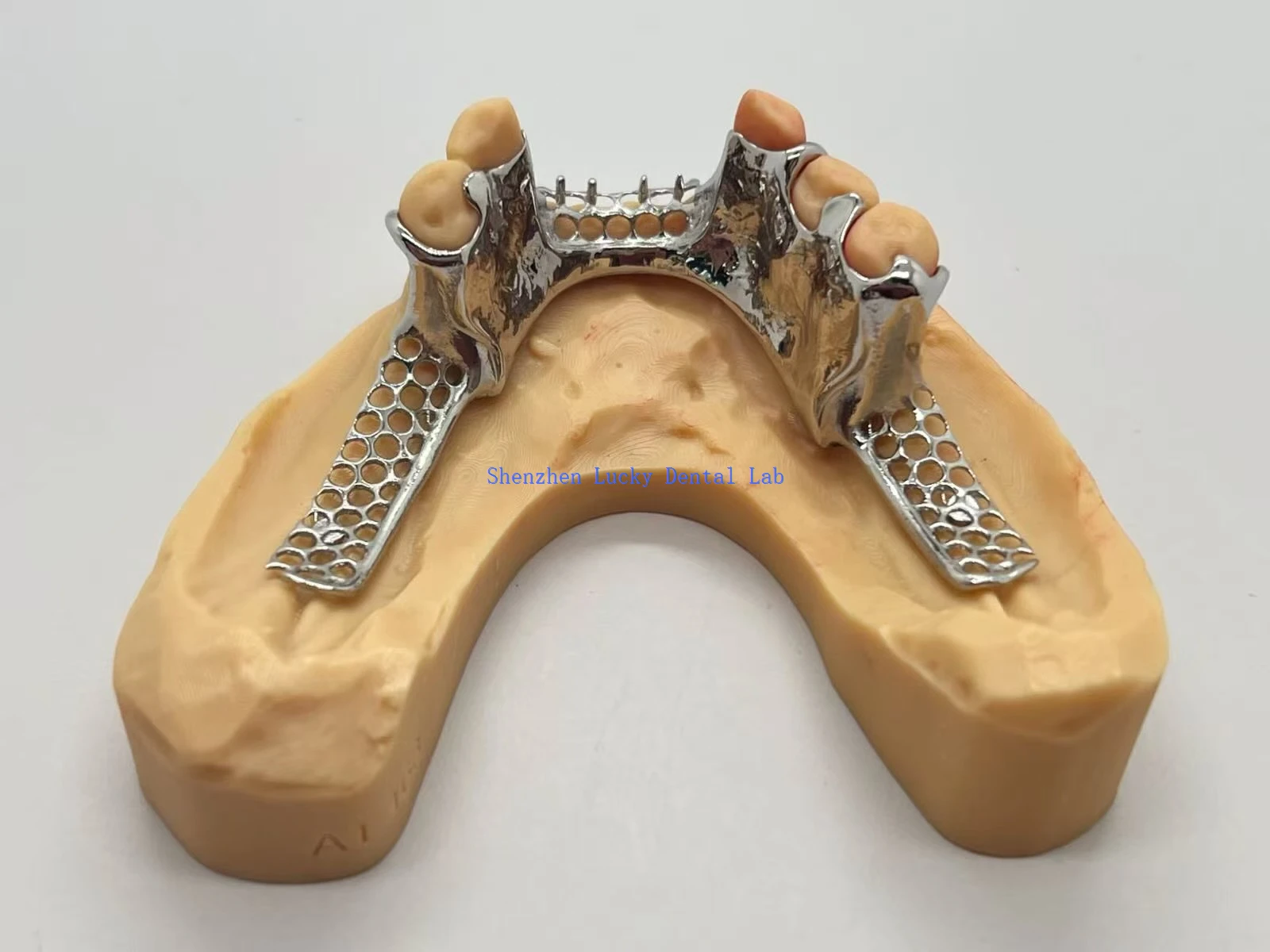
Co Cr Cast Metal Framework
Material & Manufacturing ProcessThe Co Cr Cast Metal Framework is a high-performance core component for removable partial dentures, crafted from medical-grade biocompatible cobalt-chromium (Co-Cr) alloy. It is manufactured via precision lost-wax casting technology, a gold-standard process in dental prosthetics that ensures dimensional accuracy and consistent structural integrity.
Core Performance AdvantagesBoasting exceptional rigidity, corrosion resistance and lightweight properties, this framework delivers superior retention and stability for partial dentures. It effectively distributes masticatory forces evenly across residual alveolar ridges, protecting adjacent natural teeth and soft oral tissues from excessive pressure. The custom-milled marginal design ensures a snug, irritation-free fit tailored to each patient's unique dental anatomy.
Clinical Application & CompatibilityIdeal for long-term clinical use, the framework integrates seamlessly with acrylic resin denture bases and prosthetic teeth, achieving a perfect balance between durability and aesthetic versatility. Widely preferred in global dental practices for its cost-effectiveness and reliable performance, it is a top choice for restoring patients' chewing function and smile aesthetics.
Product Details
|
Manufacturer |
Lucky Dental Lab |
|
Quality |
Great |
|
Customer service |
Professional |
|
Shipping Carrier |
UPS, FedEx, DHL, etc. |
|
Guarantee |
5 years |
|
turnaround time |
3 days in lab |
Picture
FAQ
Is the precision lost-wax casting process of the Co Cr Cast Metal Framework applicable to all partial denture designs?
The precision lost-wax casting process for the Co Cr Cast Metal Framework is highly adaptable to most partial denture designs, but it is not universally applicable to every single design scenario. Here is a detailed breakdown:
Applicable scenarios
It works exceptionally well for standard partial denture frameworks, including those with clasps, rests, and connectors for patients with moderate to extensive tooth loss.
It is suitable for customized designs tailored to unique oral anatomies, as the lost-wax process allows for precise replication of intricate wax patterns, ensuring a snug fit with residual teeth and alveolar ridges.
It is ideal for frameworks requiring complex structural details, such as multiple abutment tooth clasps or cross-arch connectors, due to its ability to capture fine dimensional features.
Limited or non-applicable scenarios
For ultra-miniaturized frameworks (e.g., micro-connectors for minimal tooth retention cases), the lost-wax process may have limitations in maintaining extreme precision, as shrinkage during casting could affect tiny components.
It is less suitable for temporary partial denture frameworks that prioritize low cost and rapid production, since lost-wax casting involves multiple steps (wax pattern making, investment, casting, finishing) which are relatively time-consuming compared to alternative processes like milling of pre-fabricated metal sheets.
For designs requiring variable thicknesses in micron-level precision (e.g., some implant-supported partial denture frameworks), advanced CNC milling may be a more reliable option than traditional lost-wax casting.