


Shenzhen Lucky Dental Laboratory Co., Ltd. is one of the leading manufacturers and suppliers of high quality dental cocr post core in China. With abundant experience, we warmly welcome you to buy discount high quality dental cocr post core from our factory. We also accept customized orders.
Products Description
High Quality Dental CoCr Post Core
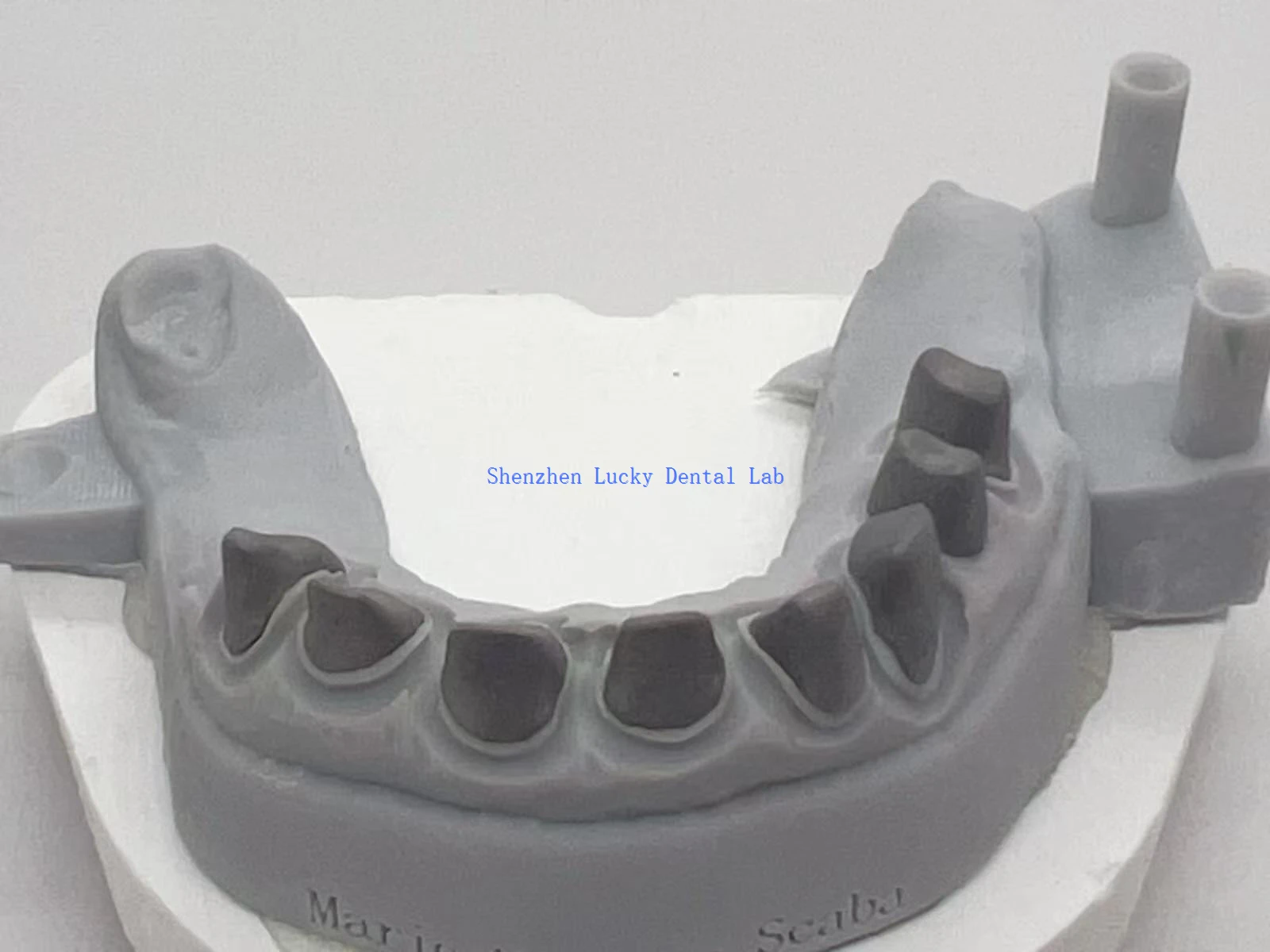
Dental CoCr Post Core, a restoration component made of cobalt-chromium (CoCr) alloy, plays a critical role in rebuilding severely damaged teeth. Designed to fit into root canals after endodontic treatment, it provides structural support for crowns or bridges, preventing tooth fracture under biting forces.
CoCr's high tensile strength (≈800 MPa) and corrosion resistance make it ideal for withstanding long-term occlusal loads, outperforming nickel-chromium alloys in biocompatibility-reducing allergy risks. Its thin, precise design (custom-cast or 3D-printed) ensures tight adaptation to root canals, minimizing microleakage and bacterial intrusion.
Widely used for posterior teeth with extensive decay or trauma, it bridges residual tooth structure and the final prosthetic, enhancing restoration longevity. Compatible with both PFM and all-ceramic crowns, it balances strength and versatility in complex cases.
Product Details
|
Manufacturer |
Lucky Dental Lab |
|
Quality |
Great |
|
Customer service |
Professional |
|
Shipping Carrier |
UPS, FedEx, DHL, etc. |
|
Guarantee |
5 years |
|
turnaround time |
3 days in lab |
Picture
FAQ
What is the role of the Dental CoCr Post Core in dentures?
The Dental CoCr Post Core in dentures primarily provides structural support to severely damaged or endodontically treated teeth, reinforcing residual tooth structure to withstand occlusal forces and prevent fracture. It acts as a bridge between the root canal and the final prosthetic (like crowns or bridges), ensuring a secure fit. Its high strength, corrosion resistance, and biocompatibility (reducing allergy risks vs. nickel-chromium alloys) enhance the longevity and stability of the denture restoration.